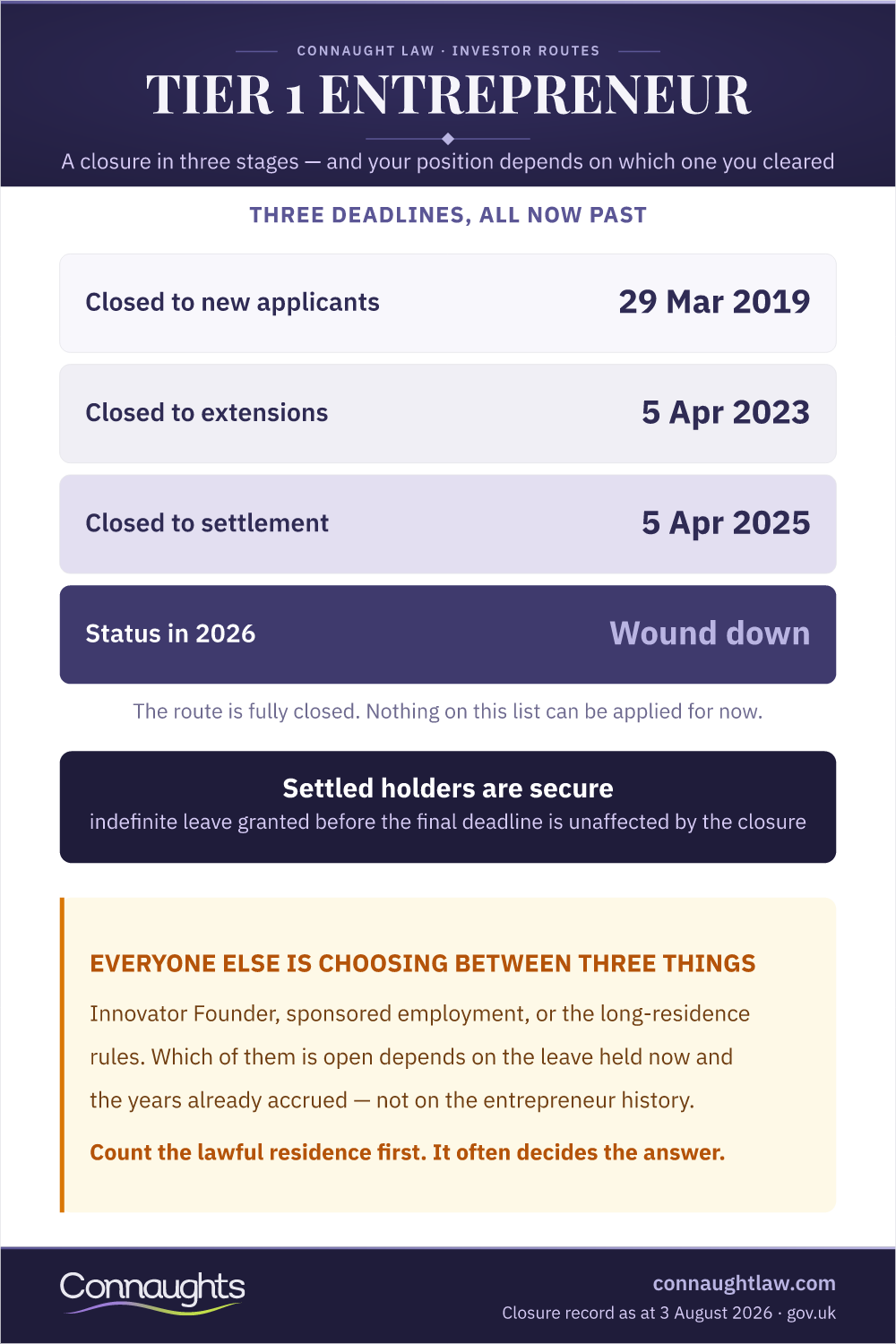
The Tier 1 Entrepreneur visa closed in three stages: to new applicants on 29 March 2019, to extensions on 5 April 2023, and to settlement applications on 5 April 2025. In 2026 the route is fully wound down — which makes your position a matter of which side of those deadlines you landed on. Settled holders are secure; everyone else is choosing between the Innovator Founder route, sponsorship and the long-residence rules.
On This Page
Three Deadlines, Three Very Different Positions
Tier 1 (Entrepreneur) let founders build UK businesses on £200,000 of investment funds — or £50,000 from approved sources — and it closed the way big routes do: slowly, deadline by deadline, over six years. Nothing can now be applied for under it. What this guide does is sort former holders into their actual 2026 positions, because the right next step for each is completely different.
New applications ended 29 March 2019, extensions ended 5 April 2023, and the final settlement window closed on 5 April 2025. Anyone who settled in time holds indefinite leave unaffected by the closure. Anyone who did not needed to switch routes before their leave expired — and anyone who let it lapse needs regularisation advice, not route comparison.
The Closure Timeline
The wind-down was published years in advance, and its dates now define everything: 29 March 2019 (no new applicants), 5 April 2023 (no extensions), 5 April 2025 (no settlement applications under the route). The staged design gave every compliant holder a lawful path to the end — which is exactly why the Home Office shows little sympathy to those who missed it. The route's history sits alongside the other closures of the same reform era, from the Start-up visa to the Sole Representative route.
Where You Stand After the Final Deadline
If You Settled Before 5 April 2025
Your indefinite leave to remain is permanent and entirely unaffected by the route's closure. The remaining journey is citizenship: naturalisation normally 12 months after settlement, with your Tier 1 Entrepreneur years counting towards the residence requirements. Keep an eye only on the ordinary ILR conditions — chiefly that absences from the UK of two years or more can cost the status itself.
Where the Deadline Was Missed
If you switched to another route in time — Innovator Founder to continue the business, Skilled Worker under sponsorship, or another category — your lawful residence continued and your settlement clock now runs under that route's rules. If your leave lapsed instead, the priority is urgent, honest advice: overstaying breaks continuity, damages every future application and can trigger re-entry bans, and the options narrow with each month the gap grows.
The Successor Route in Brief
The Innovator Founder visa is where entrepreneur migration now lives: endorsement of a new, innovative, viable and scalable business, no fixed investment minimum, B2 English — a requirement this route has carried since launch — and settlement after three years. Fees at the rates in force from 8 April 2026 are £1,357 outside the UK or £1,693 in-country, plus the £1,000 endorsement. The full requirements, business-plan tests and settlement criteria are kept in one place: our Innovator Founder requirements guide.
Realistic Alternatives Compared
Alternative Business Routes Compared
| Route | Core requirement | Settlement |
|---|---|---|
| Innovator Founder | Endorsed new, innovative, viable, scalable business | 3 years, against achievement criteria |
| Skilled Worker | Job offer from a licensed sponsor at the salary threshold | 5 years |
| Global Talent | Endorsement as a leader or potential leader in the field | 3–5 years by category |
| UK Expansion Worker | Senior role establishing an overseas business's first UK base | None directly — a stepping-stone route |
Sponsorship-side detail for the employer routes — including self-sponsorship through your own company — is mapped in our sponsorship routes directory and the Expansion Worker guide.
Settlement Paths That Still Count Your Years
Lawful Tier 1 Entrepreneur residence is not wasted time. It counts towards the ten-year long residence route where continuity was never broken, and it counts towards naturalisation once settled by any path. The trap is the word "continuity": a single out-of-status gap between routes resets the ten-year clock, which is why the missed-deadline cohort's first task is always establishing exactly when each period of leave began and ended.
Common Transition Mistakes
- Assuming an established, profitable business will sail through Innovator Founder endorsement — the innovation test is about the idea, not the accounts, and ordinary trading businesses fail it.
- Treating the 28-day fund-holding and evidence rules casually — the financial paperwork standards are as unforgiving as the old route's ever were.
- Applying with weeks left on the clock — endorsement runs on assessors' timetables, and only the Home Office stage can be paid to hurry.
- Ignoring a status gap in the hope it goes unnoticed — it is the first thing every future caseworker sees.
Questions about the closed entrepreneur route
When did the Tier 1 Entrepreneur visa close?
In stages: to new applicants on 29 March 2019, to extension applications on 5 April 2023, and to settlement applications on 5 April 2025. As of 2026 no application of any kind can be made under the route.
Can I still apply for settlement as a Tier 1 Entrepreneur?
No — that window closed on 5 April 2025. Settlement now comes through whichever route you hold instead: Innovator Founder after three years, Skilled Worker after five, or the ten-year long residence route where continuous lawful residence supports it.
Does my time on the route still count for anything?
Yes. Lawful Tier 1 Entrepreneur residence counts towards ten-year long residence where continuity held, and towards naturalisation once you are settled. What breaks its value is a gap in status between routes — which is why the transition dates matter so much.
Do I need £50,000 for the Innovator Founder route?
No. The successor route has no fixed investment minimum — endorsing bodies assess whether the funding matches the business plan. The £200,000 and £50,000 thresholds belonged to the closed route and appear nowhere in the current rules except as settlement-achievement evidence.
What English level does the successor require?
CEFR B2 across speaking, listening, reading and writing — a level the Innovator Founder route has required since its launch in April 2023, and a step up from the old route's B1. Approved tests or recognised degree-based exemptions satisfy it.
My leave expired and I never switched — what now?
Get advice before applying for anything. Overstaying breaks continuous residence, must be declared, and shapes which options remain — some gaps are explicable and survivable, others push the realistic path to fresh entry clearance from abroad. The gap's exact dates decide everything.
Tell us the dates of your last Tier 1 Entrepreneur leave, what you hold now and whether the business is still trading. We'll tell you which side of the deadlines you fall on and what that actually permits.
Get Expert Advice