Divorce divides what the marriage built — not necessarily everything you own. English law separates matrimonial assets, shared equally as a starting point, from non-matrimonial assets: wealth brought in, inherited or gifted, which since Standish v Standish is not shared by default at all. This guide explains what falls on each side of the line, how assets cross it, and what actually protects pre-marital wealth when a marriage ends.
On This Page

Two kinds of wealth, two different fates
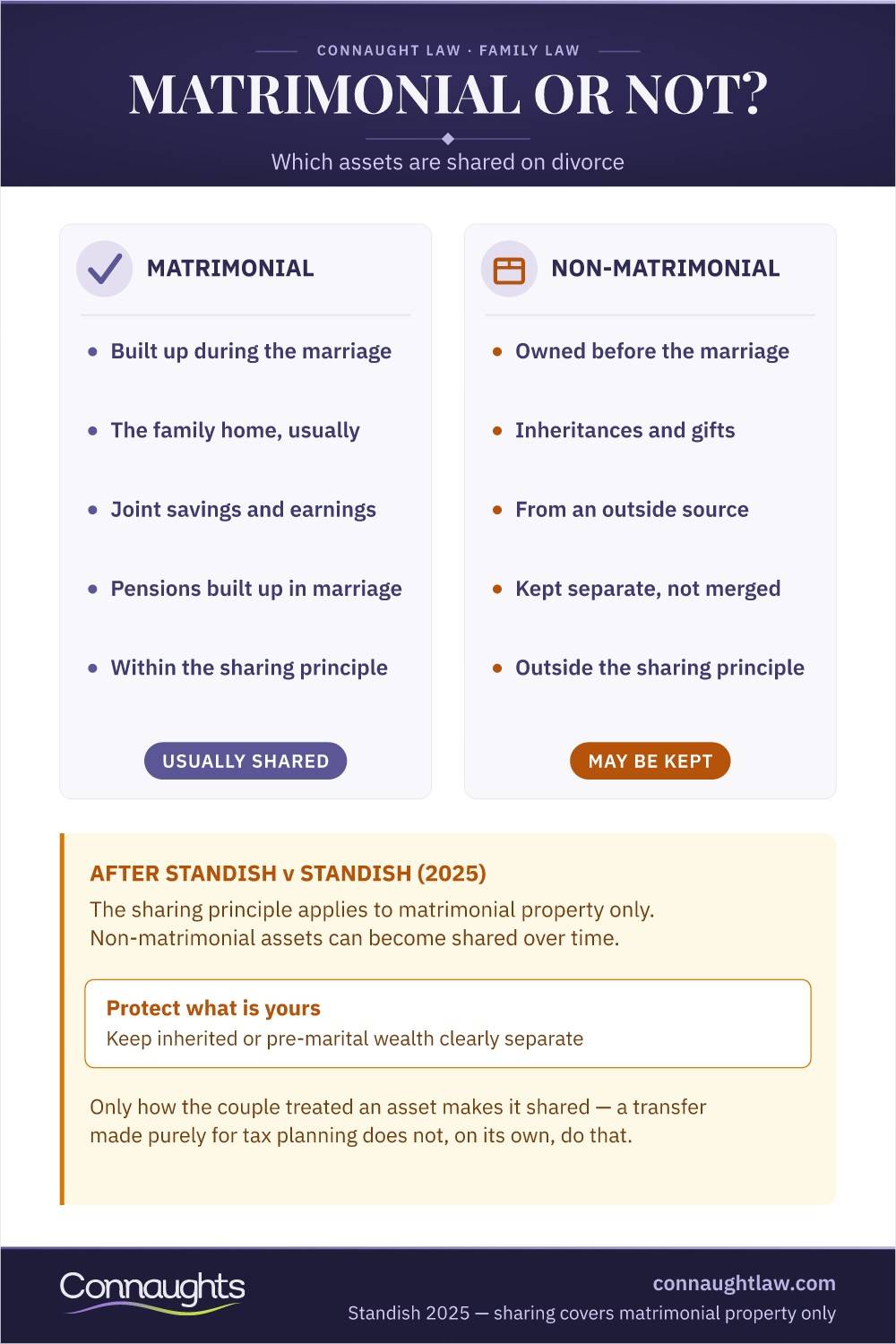
Assets generated during the marriage are divided equally as the starting point, whoever earned or owns them. Assets from outside the marriage — pre-marital wealth, inheritances, gifts — are not shared by default, but they lose that protection if treated as family money, and they remain reachable where needs cannot otherwise be met.
Classification is now where financial settlements are won and lost. In Standish v Standish [2025] UKSC 26 the Supreme Court confirmed that the sharing principle applies to matrimonial property only, and that whether an asset has been matrimonialised depends on how the couple treated it over time — a transfer made purely for tax planning did not convert around £78 million of pre-marital wealth into shared property. Our Standish analysis covers the decision in full; this guide covers the classification system it now governs.
What Are Matrimonial Assets?
Matrimonial assets are the product of the partnership: everything the couple built between the wedding and the separation, regardless of whose name it sits in or who earned the money that bought it. Equal contribution is assumed — the earner and the homemaker rank the same — which is why arguments about who paid for what rarely move a court.
Core Categories
- The family home — almost always, even when owned before the marriage or held in one name.
- Earnings, savings and investments accumulated during the marriage.
- Pensions, to the extent built up between wedding and separation.
- Businesses grown by marital endeavour, and the marital growth in pre-existing ones.
- Contents, vehicles and the general infrastructure of family life.
Marriage Duration and Classification
Length changes the map. In long marriages the origins of wealth fade: separate assets get used, merged and rebuilt until little remains distinctly non-matrimonial. Short marriages preserve boundaries — courts lean towards returning each party to their pre-marriage position, and sharing claims over wealth the marriage did not create are at their weakest. Duration is not a rule but a gradient, and every year of integration moves assets along it.
Non-Matrimonial Assets and How They Stay Protected
Non-matrimonial property is wealth the marriage did not generate. It sits outside the sharing principle — but its protection is behavioural, not automatic: an inheritance spent on the family home becomes family wealth, however carefully its arrival was documented. The categories below are starting points; treatment decides the finish.
Categories of Non-Matrimonial Assets
Non-Matrimonial Categories
| Category | Protection Potential | What Protection Requires |
|---|---|---|
| Pre-marital property | High, while kept separate | Sole ownership, no commingling, records of what was brought in |
| Inheritance | High, while kept separate — family use erodes it | Separate holding and management; probate papers retained |
| Gifts from third parties | High, with clear gift intention | Documented donor intention and separate holding |
| Post-separation assets | Moderate | A clear separation date and genuinely independent acquisition |
| Personal injury awards | High for personal compensation | Kept identifiably separate from family finances |
Keeping Pre-Marital Wealth Separate
The pattern that protects is consistency: the asset owned before the marriage stays in the sole name it arrived in, is never routed through the joint account, receives no matrimonial money for improvements, and funds nothing the family lives on. Break the pattern once and the argument survives; make family use the norm and the classification quietly flips.
Pre-Marital Assets and What Happens to Them
Three variables decide the outcome for assets you brought in. First, the marriage's length — the longer it ran, the more the origin fades. Second, mixing: pre-marital money blended with joint finances, or the pre-marital house that became the family home, loses its separate character — the clearest example there is. Third, and decisively, needs: where the remaining assets cannot house and support both parties, the court reaches for whatever exists, however it was acquired. Recording what you brought in, keeping it in your sole name and avoiding family use all help; a ring-fencing strategy combining them helps more.
How Courts Divide Assets: The Section 25 Exercise
Classification feeds a wider statutory exercise. Section 25 of the Matrimonial Causes Act 1973 requires the court to weigh all the circumstances, with first consideration to the welfare of minor children — and the factors below are the checklist every settlement is tested against, agreed or imposed.
Factors the Court Must Weigh
- Each party's financial resources and earning capacity, now and foreseeable.
- Financial needs, obligations and responsibilities.
- The standard of living before the breakdown.
- Ages and the duration of the marriage.
- Any physical or mental disability.
- Contributions to the family's welfare — including home-making and childcare.
- Conduct, in the rare cases where it would be inequitable to ignore.
- Benefits lost through the divorce, pensions above all.
Sharing, Compensation and Needs
The case law organises those factors through three principles: equal sharing of matrimonial wealth, compensation for relationship-generated sacrifice in exceptional cases, and — dominating most real settlements — meeting both parties' reasonable needs. Where needs and sharing point different ways, needs win. Our guide to the sharing principle works through how the three interact.
Pensions on Divorce
Pensions are matrimonial property to the extent they were built up during the marriage, and after the family home they are usually the largest asset in the case. They are also the one most often traded away cheaply, because a transfer value on paper says little about the income it will actually produce. Valuation, sharing and offsetting have their own mechanics — our pensions on divorce guide covers them properly.
Asset Protection Strategies and Future Planning
Prenuptial Agreements
A prenuptial agreement is the most direct protection available: it records what each party brings in and how it is to be treated, answering the classification question before it can be litigated. Made with disclosure, independent advice and fair provision for needs, agreements are now followed in the great majority of cases — and Standish's emphasis on documented intention only strengthens them.
Trust Structures and Corporate Protection
Trusts and corporate structures can hold wealth outside the matrimonial pot, but courts see through arrangements built solely to defeat claims: structures need genuine commercial or succession purpose, independent governance and a history predating marital difficulty. Even then, needs retain their override — a court that cannot meet needs from free assets will treat trust interests as a resource. In high-value cases, structure and family law advice need to be designed together, not sequentially.
Frequently askedQuestions about what is shared, what is protected and why
What are matrimonial assets in UK divorce proceedings?
Everything the marriage generated: the family home, savings, pensions built during the marriage, businesses grown by marital effort and the assets of family life — whoever owns or earned them. They are shared equally as the starting point, with contributions at home ranking equally with earnings.
How are assets divided in a divorce under UK law?
Through the section 25 exercise: classify the assets, share the matrimonial pot equally as a starting point, then test the result against both parties' needs — children's welfare first. Needs can justify departing from equality and reaching non-matrimonial wealth where nothing else meets them.
What counts as non-matrimonial assets in divorce?
Wealth from outside the marriage: assets owned before it, inheritances, third-party gifts, genuinely post-separation acquisitions and personal injury awards. Since Standish they are not shared by default — but protection depends on keeping them separate in holding, records and use.
Are pre-marital assets protected in UK divorce proceedings?
Often, if kept genuinely separate — and always subject to needs. A short marriage with clean separation of assets protects well; a long marriage where pre-marital wealth funded family life does not. Where needs cannot otherwise be met, origin gives way.
How do courts approach business assets in divorce?
The business is valued — usually by a single joint expert — and its matrimonial element identified: a company built during the marriage is shared, while pre-marital businesses are shared to the extent of marital growth. Courts prefer leaving the business with the running spouse and balancing with other assets.
What happens to inheritance received during marriage?
It starts non-matrimonial and stays that way if held and managed separately. Spent on the family home or folded into joint finances, it matrimonialises. And whatever its classification, it remains available where the other assets cannot meet both parties' needs.
Can prenuptial agreements protect assets during divorce?
Yes — a properly made agreement, with disclosure, independent advice and fair provision for needs, is normally followed. It settles classification in advance: what each party brought in, and what any transfers between you were intended to mean. It cannot oust the needs jurisdiction.
How does asset division differ in short marriages?
There is no statutory definition of a short marriage, but in one — broadly a childless marriage of a few years — courts lean towards restoring each party's pre-marriage position: non-matrimonial assets are better protected, sharing claims are weaker and clean breaks are common.
How long does the asset division process take?
An agreed settlement converted to a consent order can complete within the divorce itself. Contested proceedings run to the court's timetable — months as a minimum, and past a year where business valuations, trust structures or international assets are in play. Early disclosure shortens everything.
Tell us what the asset is, when it arrived and how it has been used during the marriage. We will tell you its likely classification and what to do now to protect it.
Get Expert Advice